Evaluate simulation recovery
A simulation gives you the true spectra and abundance maps. Compare them with the fitted spectra and maps to measure how much of each component the fit recovered.
Run Estimate unknown spectra through Refine the spectra with MCR-ALS to create the ternary image and the abundance estimates used here.
Compare fitted factors with ground truth
In the simulation we know the true spectra and abundance maps.
concentration_error_maps matches component order and brings the factors
to the same scale before subtracting truth from the estimates.
evaluate_factors summarizes recovery over the pixels you pass in.
Here we use the triangle mask so empty background does not dilute the
abundance RMSE.
from lumic.evaluation import concentration_error_maps, evaluate_factors

recovery_maps = concentration_error_maps(
    true_counts, spectra, refined_maps.data, refined_spectra,
)
recovery = evaluate_factors(
    image.data[inside], true_counts[inside], spectra,
    refined_maps.data[inside], refined_spectra,
)
for name, shape_error, rmse in zip(
    names, recovery.spectral_relative_l2_per_component, recovery.abundance_rmse_per_component,
):
    print(f"{name}: spectral shape distance {shape_error:.3f}, abundance RMSE {rmse:.1f} counts")
The spectral shape distance compares spectra after scaling each to unit L2 norm. The abundance RMSE here is in detected counts. For an individual component, the signed map shows overestimation and underestimation, and the absolute map also shows false positives where the true abundance is zero. Relative abundance error is only defined where the true abundance exceeds the threshold.
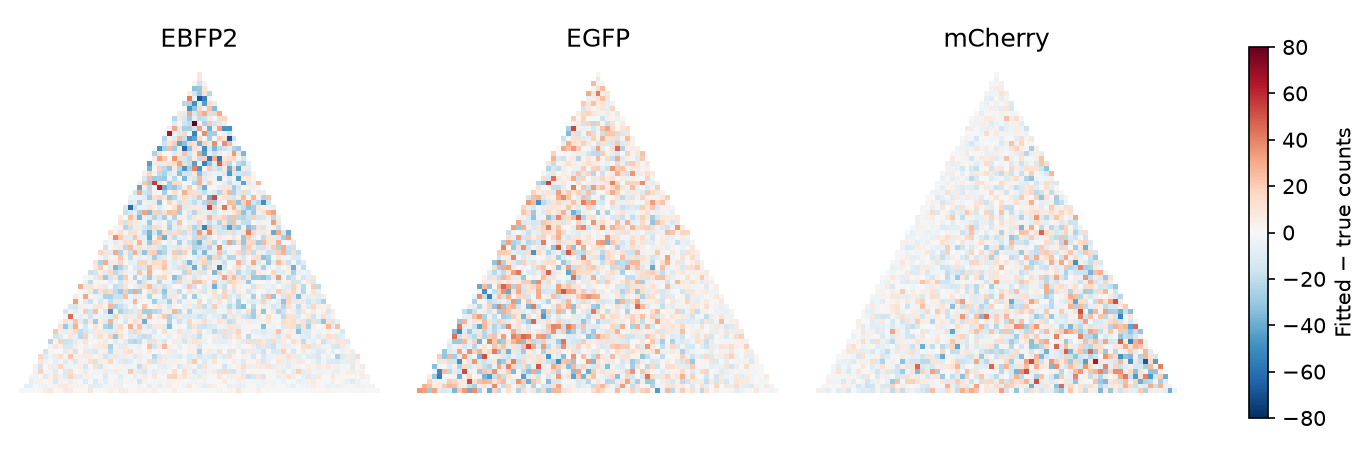
Red shows overestimation and blue shows underestimation. The shared color scale makes the size of the error comparable across components.
For a separate check of how closely the model predicts the detector signal, see Evaluate experimental data. The reconstruction diagnostics there also apply to simulations.