Recover a spectrum without pure pixels
Can MCR-ALS estimate a fluorophore's spectrum when it always appears in a mixture? This example simulates that situation for EGFP and compares the initial and refined spectra. The fit receives the simulated image and a component count of three. The reference spectra are used to create the image and evaluate the result.
Run the blocks below in order using the environment from the quickstart. For an introduction to the workflow, see Estimate unknown spectra.
Simulate a mixture with no pure EGFP pixel
From bottom to top, the EGFP fraction rises from 0% to 25%. At every row, the remaining counts shift from EBFP2 on the left to mCherry on the right. The two bottom corners still have pure EBFP2 and pure mCherry, but each pixel with EGFP also contains at least one other fluorophore. Leave out shot noise for this run to isolate the effect of missing the pure EGFP pixel.
import numpy as np

from lumic import SpectralImage
from lumic.simulation import (
    SpectralDetector,
    load_offline_emission_spectrum,
    simulate_linear_mixture,
)

names = ("EBFP2", "EGFP", "mCherry")
detector = SpectralDetector.from_profile("980_32ch")
spectra = np.array([
    detector.sample(*load_offline_emission_spectrum(name))
    for name in names
])
spectra /= spectra.sum(axis=1, keepdims=True)

row, col = np.indices((20, 20), dtype=float) / 19
egfp_fraction = 0.25 * (1 - row)
remaining = 1 - egfp_fraction
hidden_true_counts = 1000 * np.stack(
    (remaining * (1 - col), egfp_fraction, remaining * col), axis=-1,
)
hidden_simulation = simulate_linear_mixture(
    hidden_true_counts, spectra, detector.channel_centers, fluorophore_names=names,
)
hidden_image = SpectralImage(data=hidden_simulation.image, axes="YXC")
hidden_pixels = hidden_image.unfold().data
Estimate and refine the spectra
Select three starting spectra from the convex hull of the measured pixel spectra. MCR-ALS then refines those starting spectra using all 400 pixels.
from lumic import essential_spectral_pixles, mcr_als, unique_profiles

n_components = 3
hidden_hull, _ = essential_spectral_pixles(hidden_pixels, npc=n_components)
hidden_initial, _ = unique_profiles(hidden_hull.T, nr=n_components, f=0.5)
hidden_initial = hidden_initial / hidden_initial.sum(axis=1, keepdims=True)

_, hidden_refined, hidden_history, hidden_diagnostics = mcr_als(
    hidden_pixels, hidden_initial, nIter=500, normL="L1",
    tol_percent=0.1, return_diagnostics=True,
)
print(f"{hidden_diagnostics.iterations_completed} updates ({hidden_diagnostics.stop_reason})")
Compare with the simulation
Match both sets of spectra to the known references for evaluation. The relative L2 spectral error measures the overall difference across channels, divided by the L2 norm of the simulated spectrum. It gives a percentage for each component.
from lumic.evaluation import match_components

hidden_initial_order, _ = match_components(spectra, hidden_initial)
hidden_refined_order, _ = match_components(spectra, hidden_refined)
reference_norm = np.linalg.norm(spectra, axis=1)
for stage, basis in (
    ("Initial", hidden_initial[hidden_initial_order]),
    ("Refined", hidden_refined[hidden_refined_order]),
):
    relative_error = np.linalg.norm(basis - spectra, axis=1) / reference_norm
    print(stage, dict(zip(names, [f"{value:.1%}" for value in relative_error])))
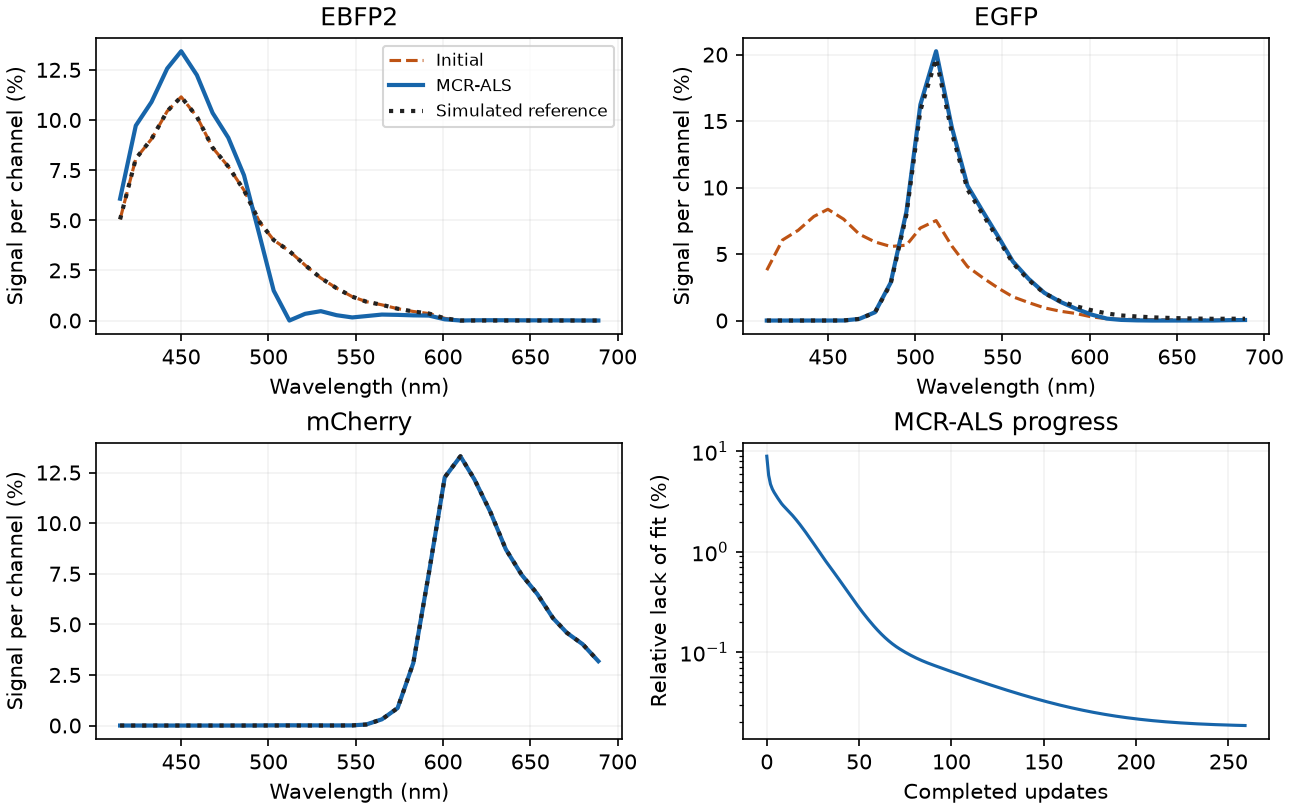
In this run, MCR-ALS converges after 259 updates and the EGFP spectral error drops from 81% to 3.7%. At the same time, the EBFP2 spectral error rises from near zero to about 28%, as its refined spectrum picks up a feature near the EGFP peak.
MCR-ALS can recover a close approximation of a spectrum even when every pixel containing it is mixed. The result depends on the mixtures in the image, the starting spectra, and the noise. Several sets of spectra and abundance maps can explain the same data, so a small reconstruction error alone cannot establish that the recovered components are accurate or unique.